Gran fondo nutrition: what to eat and drink on race day
Plan carbohydrate loading, breakfast, hourly fuel and hydration for a gran fondo, with practical aid-station and stomach-problem decisions.
Listen to this article
You can have the legs for five hours and still lose your gran fondo to a late breakfast, a badly mixed bottle or the feed you forgot on the first climb. The answer is not to eat as much as possible. It is to start with fuel available and follow a plan that already works when you ride hard.
The direct answer is this: prepare carbohydrate across the preceding 36–48 hours when the event warrants it, eat breakfast early enough, begin fuelling in the first hour, and match fluid, sodium and concentration to your losses and tolerance. Race day is not the place to introduce new products or targets.
What changes between training and racing?
A race gives you fewer opportunities to correct a mistake. Pace, heat, aid-station locations and event-day tension can turn a food you tolerate at rest into a poor choice on the bike. At high intensities, especially when hypohydrated, blood flow to the digestive system falls. This is one of several mechanisms associated with nausea, bloating, pain and diarrhoea during exercise.[1]
Gastric emptying does not have one fixed capacity either. It changes with intensity, volume, energy density, drink concentration and the individual.[2] A number you tolerate for three easy hours may fail during a fast, hot event.
How to carbohydrate-load without turning dinner into an eating contest
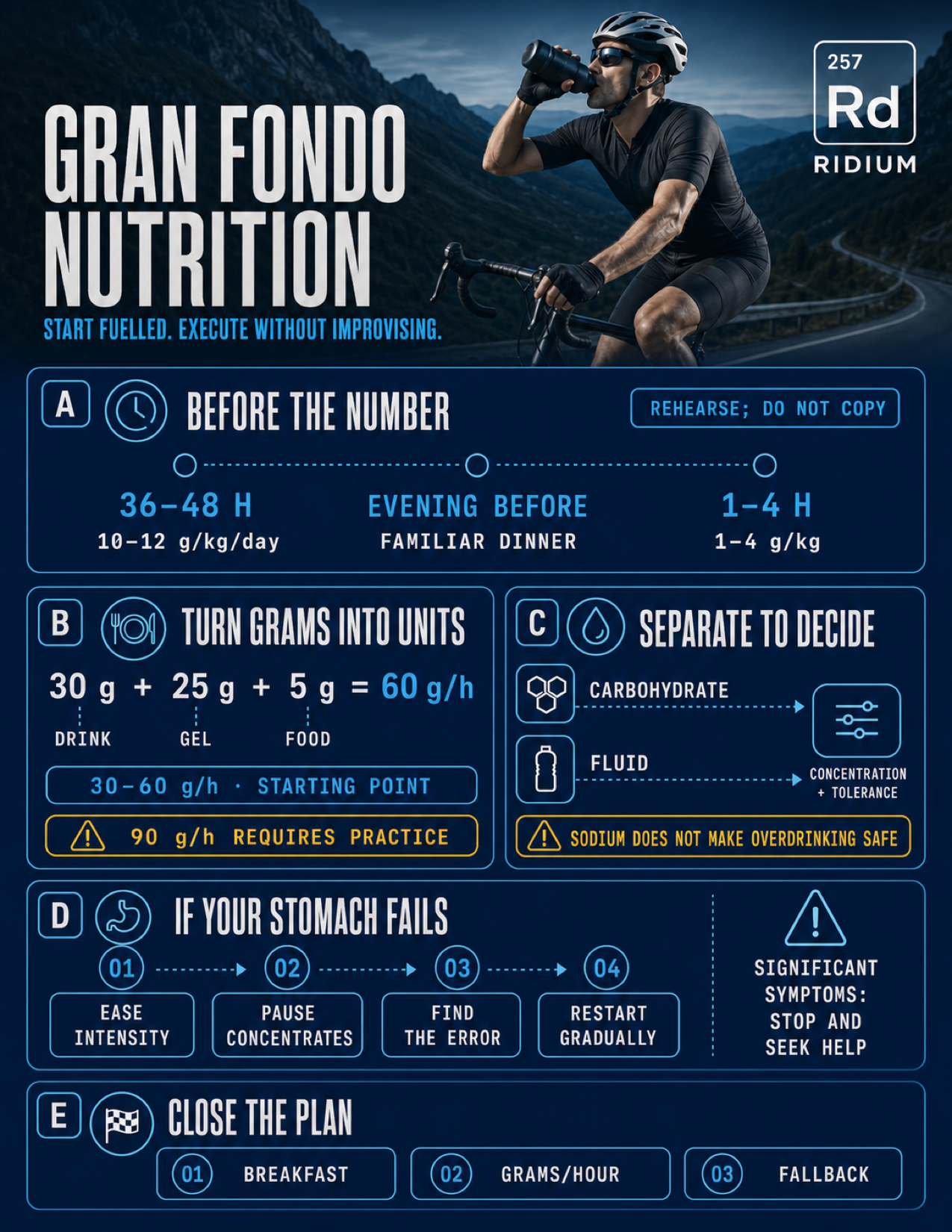
Carbohydrate loading is not one enormous bowl of pasta on the evening before the event. For prolonged endurance competition, the contemporary protocol concentrates a high carbohydrate intake—commonly around 10–12 g/kg/day—across the preceding 36–48 hours, alongside a reduction in training load.[3]
That range can be difficult to execute, and it does not require doubling the volume of every meal. Increase the share of familiar foods such as rice, pasta, bread, potatoes, fruit and carbohydrate drinks. Reduce fibre and fat if they tend to cause discomfort. The aim is high carbohydrate availability without reaching the start line with an overloaded digestive system.
For a 70 kg rider, 10 g/kg means 700 g of carbohydrate per day. That is a high intake, not casual advice for every sportive. If you have never rehearsed it, do not attempt the full protocol before your priority event. A sports dietitian can help match it to your size, expected duration and tolerance.
The night before
Choose a familiar meal that is rich in carbohydrate, moderate in protein and relatively low in fat, with an amount of fibre you tolerate. Rice, pasta, bread or potatoes can all work. Do not treat dinner as a capacity test: the main work is spread through the day and, when appropriate, starts the day before that.
What to eat before the start
Guidelines provide a broad reference of 1–4 g/kg of carbohydrate in the 1–4 hours before exercise. The amount rises with the event demand and the time available for digestion, but it still has to fit your tolerance.[4]
With two or three hours available, a familiar meal that is low in fat and fibre is usually easier to manage: toast with jam and yoghurt, oats you already tolerate, or rice with a moderate serving of protein. There is no single perfect race breakfast.
For a very early start, reduce the volume and choose an amount you can digest. Completing part of the intake with a carbohydrate drink or small early-race feeds can be practical, but only after rehearsal. Sacrificing sleep to force down an impossible breakfast has a cost too.
| Timing | Objective | Practical decision |
|---|---|---|
36–48 h before | Increase carbohydrate availability when the event warrants it | Spread the load; do not concentrate it in one dinner |
| Evening before | Start with high stores and a calm gut | Familiar carbohydrate-rich meal, moderate in fat and fibre |
1–4 h before | Restore liver glycogen and provide fuel | Match 1–4 g/kg to the time available and your tolerance |
| Final minutes | Avoid improvisation | Only use a small familiar feed if it belongs in your plan |
How much carbohydrate to take during a gran fondo
Intake should scale with duration, intensity and gastrointestinal capacity. As a practical framework, the literature suggests 30–60 g/h for sustained work lasting roughly one to two and a half hours, and up to 90 g/h for longer events when you use carbohydrates transported through different pathways, such as glucose and fructose.[5]
90 g/h is not a minimum or a law. It requires practice, products whose composition you understand, and a plan that works at race intensity and in race-day weather. Some riders tolerate more and recent research is studying higher intakes, but that does not make 100 or 120 g/h a universal recommendation for an amateur gran fondo.
Begin with the target you rehearsed and split it into units that are easy to remember. If the goal is 60 g/h, you might take two feeds of 30 g or three of 20 g. Exact frequency matters less than regular execution and a total you can genuinely sustain.
Build an inventory sheet
| Example product | Carbohydrate per unit | Units per hour | Total |
|---|---|---|---|
| Familiar drink | 30 g | 1 | 30 g |
| Familiar gel | 25 g | 1 | 25 g |
| Small food portion | 5 g | 1 | 5 g |
| Example total | 60 g/h |
Read your labels: a gel does not always contain 25 g, and a bottle does not always contain 30 g. Count carbohydrate in the drink. If you double the powder in a bottle because the day is hot, you have changed energy, concentration and hydration at the same time.
Must every gel be taken with water?
Not as a universal rule. Follow the product directions and consider the total concentration entering your stomach. Concentrated gels are often easier to tolerate with water; taking one alongside a very concentrated sports drink can create a large carbohydrate dose at once. Some formulations, however, are isotonic or designed for use without water.
The useful decision is to separate fuel and fluid in your plan. Define the grams you take and the volume you drink, check the resulting concentration, and repeat that combination in training. Glucose–fructose solutions can improve carbohydrate and fluid delivery compared with glucose alone under studied conditions, but responses still vary.[6]
At an aid station, prioritise familiar products that are easy to open and safe to eat while moving. A banana, bar, rice cake or gel may all work. Composition, tolerance and safe handling matter more than the category.
How to plan hydration and sodium
No fluid volume per hour fits everyone. Sweat rate changes with heat, humidity, clothing, intensity, body size and acclimatisation. Guidelines recommend an individual plan that limits excessive dehydration without encouraging overdrinking.[7]
Estimate sweat rate in training that resembles the event:
sweat rate ≈ (pre-ride weight − post-ride weight + fluid consumed − urine) ÷ hours
Repeat the measurement in different conditions. Use the result to plan bottles and refill points, not to force replacement of every millilitre lost.
Sodium can support fluid retention and replace part of what you lose, especially in long, hot events or when you sweat heavily. Sweat sodium concentration varies, so one standard tablet cannot answer every rider's needs. Rehearse the strategy, count what is already in your drink, and do not add capsules by reflex.
What to do when your stomach starts to fail
Mild discomfort does not call for the same response as repeated vomiting, severe pain, confusion or declining coordination. Stop and seek medical assistance for significant symptoms.
If mild bloating or nausea appears:
- Reduce intensity. Hard exercise can worsen gastrointestinal tolerance.
- Stop adding concentration. Pause solids or concentrated gels and take small sips according to thirst and tolerance.
- Find the error. Did you stack several feeds, drink too much at one aid station or switch products?
- Restart gradually. If symptoms improve, use small amounts of a familiar source; do not chase the entire deficit in one feed.
Cola at an aid station can provide sugar and caffeine, but it is not a universal treatment. If you have not tested it, have already consumed caffeine or dislike carbonation, it may make matters worse. A gastrointestinal crisis is not guaranteed to resolve when you drop to zone 2. Reducing effort is prudent, not a physiological promise.
Train the plan, not just the gut
In a small trial of 18 runners, two weeks of repeated feeding at 90 g/h during exercise reduced gastrointestinal symptoms and markers of malabsorption compared with placebo.[9] The study supports rehearsal; it does not prove that every cyclist needs two weeks or should begin directly at 90 g/h.
Use long rides to rehearse the complete system:
- breakfast and the interval before starting;
- grams per hour and the mixture of sources;
- bottle volume and refill locations;
- opening and carrying food;
- your response to expected heat and intensity;
- a fallback using simple foods and drinks you already tolerate.
Your race-day execution sheet
Close six decisions before you go to bed:
- Breakfast: what, how much and when.
- Carbohydrate target: grams per hour and the units that supply them.
- Hydration: starting bottles, concentration and refill points.
- Sodium: what is already included and any supplement you have actually rehearsed.
- Alerts: reminders to eat from the first hour instead of waiting for hunger.
- Fallback: what to reduce, which simple source to use and when to seek help.
Race nutrition does not start when you pin on a number. It is built in the weeks when grams, bottles and timing become an executable routine. On gran fondo day, you do not need creativity. You need to follow the plan, read the response and adjust before a small mistake decides the final 40 kilometres.
References
- Gastrointestinal Complaints During Exercise: Prevalence, Etiology, and Nutritional Recommendations — Sports Medicine, 2014↩
- Acute Exercise and Gastric Emptying: A Meta-Analysis and Implications for Appetite Control — Sports Medicine, 2015↩
- Carbohydrates for Training and Competition — Journal of Sports Sciences, 2011↩
- Nutrition and Athletic Performance — Academy of Nutrition and Dietetics, Dietitians of Canada and ACSM, 2016↩
- A Step Towards Personalized Sports Nutrition: Carbohydrate Intake During Exercise — Sports Medicine, 2014↩
- Multiple Transportable Carbohydrates Enhance Gastric Emptying and Fluid Delivery — Scandinavian Journal of Medicine & Science in Sports, 2010↩
- Exercise and Fluid Replacement — American College of Sports Medicine, 2007↩
- Statement of the Third International Exercise-Associated Hyponatremia Consensus Development Conference — Clinical Journal of Sport Medicine, 2015↩
- Gut-training: The Impact of Two Weeks Repetitive Gut-challenge During Exercise — Applied Physiology, Nutrition, and Metabolism, 2017↩
labels.help_guides_eyebrow
labels.help_guides_title
labels.help_guides_description
Turn on and read the morning readiness email
Opt in to a morning readiness verdict on workout days, choose your send hour, and understand what drives the recommendation.
Visual summary
The article at a glance
Review the key concepts in one infographic.