Cycling nutrition and hydration: what to eat and drink on every ride
Match carbohydrates, fluid and sodium to ride duration, intensity, conditions and recovery time with a practical cycling fueling plan.
Listen to this article
A bonk rarely begins when you finally lose the wheel. It usually starts earlier, when a demanding ride uses carbohydrate faster than you replace it or when you begin with too little fuel available. Power falls, perceived exertion rises and a normally sustainable pace stops being sustainable.
The practical answer is not to eat as much as possible or drink a fixed volume every hour. It is to match carbohydrate and fluid to duration, intensity, weather, tolerance and the time available for recovery.
Arriving well fed and drinking for the conditions may be enough for a short easy ride. Quality intervals or several hours on the bike need a plan that starts before you roll out. Treat the ranges in this guide as starting points to practise and adjust, not universal laws.
What actually happens when you bonk
Working muscle uses carbohydrate and fat at the same time. Their contribution changes with intensity, duration, training status and fuel availability. As intensity rises, carbohydrate becomes more important because it can support rates of energy production that fat alone cannot.
Carbohydrate is stored mainly as muscle and liver glycogen. Those stores are limited, but there is no universal ninety-minute clock and no switch that flips when glycogen reaches literal zero. Use depends on the work performed, what you ate beforehand, your training status and intake during the session.[1]
It is more accurate to describe a bonk as a marked performance decline associated with low carbohydrate availability, sometimes alongside low blood glucose, within fatigue that may also involve heat, hydration, pacing and duration. Not every bad session is a bonk, and a bonk is not explained by one variable in every rider.
How much carbohydrate do you need per hour?
Power zone alone should not decide the answer. One hour of intervals and one easy hour create different demands; a five-hour ride changes the problem again. The evidence-based framework scales intake with duration and intensity.[2]
| Duration and purpose | Starting point during the ride | How to use it |
|---|---|---|
| Up to 60 minutes, easy | Water as needed; carbohydrate during the ride is often optional | Arrive fed and avoid turning a simple ride into an unnecessary protocol |
| Around 60 minutes, very hard | Small amounts or a carbohydrate mouth rinse may help | A performance tool, not a requirement for every training session |
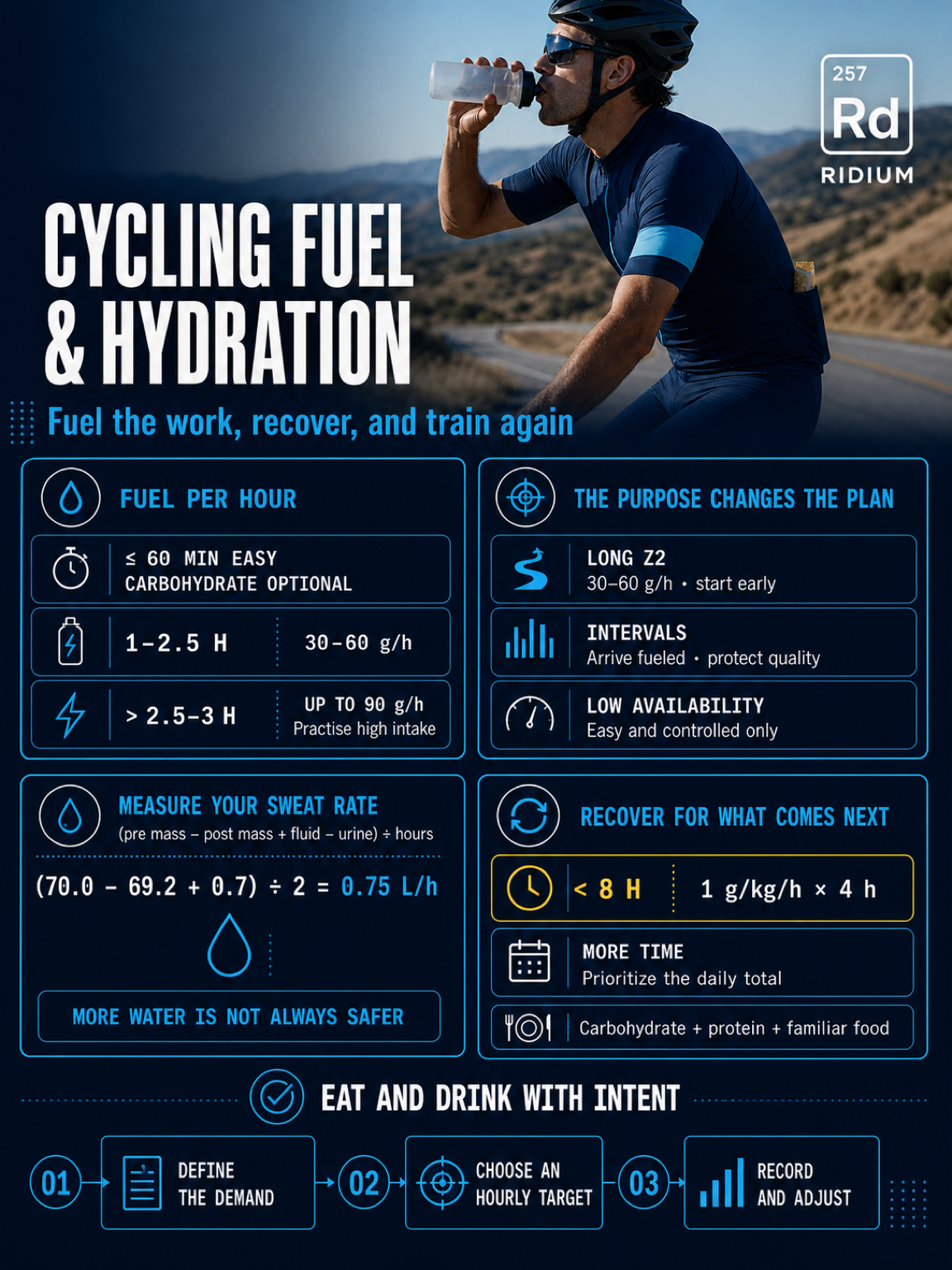
| 1–2.5 hours with sustained work | 30–60 g/h | Move toward the upper end as intensity or session priority increases |
| More than 2.5–3 hours | Up to 90 g/h when the cost and purpose justify it | High intake needs multiple transportable carbohydrates and gut practice |
Oxidation of a single carbohydrate source generally tops out around 60 g/h. Guidance for approaching 90 g/h uses combinations such as glucose and fructose because they use different intestinal transporters.[2] In one crossover study, a glucose-fructose mix improved oxidation and time-trial performance after two hours of steady cycling compared with glucose alone.[3]
That does not make 90 g/h the goal of every ride. You may need less for two easy hours after a suitable breakfast. Practising a higher intake may be specific preparation for a fast five-hour gran fondo. Start with an amount you tolerate, divide it into feeds every twenty to thirty minutes and build gradually.
Turn grams per hour into food you can carry
Read the label: a gel, bar and banana do not automatically contain the same amount. One example of 60 g/h could be:
- a drink providing
30 gof carbohydrate; - a gel providing
25 g; - a few bites of food providing the remaining
5 g.
The exact combination matters less than four questions: does it reach the target, can you tolerate it, can you consume it while riding, and does it still work after several hours? Test it in training before relying on it at your goal event.
What to eat before riding
The pre-ride meal should raise carbohydrate availability without causing gastrointestinal discomfort. Sports-nutrition guidance gives a broad reference of 1–4 g/kg during the 1–4 hours before exercise, scaled to duration, intensity, time available and individual tolerance.[4]
You do not need the upper end before an easy hour. More fuel makes sense before a long session, intervals close to or above threshold, or any workout that must be executed with high quality.
Simple options include:
- two or three hours beforehand: rice, oats, bread, fruit or another familiar carbohydrate-rich meal moderate in fat and fibre;
- thirty to sixty minutes beforehand: a banana, toast with jam, a carbohydrate drink or another tested snack;
- with a sensitive stomach: reduce fat, fibre and total volume, and do not introduce a new food.
One pre-ride meal cannot repair a week of low energy intake. You also do not need a premium recovery product when familiar foods meet the target and sit well.
Three training scenarios
Long zone 2 ride: preserve fuel and practise
Over three to five hours, duration accumulates glycogen use even at a moderate intensity. Begin eating early and regularly. 30–60 g/h is a reasonable initial range; where you sit within it depends on pace, terrain, purpose and what you need to do the following day.
When the ride prepares you for an event, use selected sessions to rehearse the event strategy: food format, flavour, timing and storage. Tolerating a product at home does not prove it will work after four hot hours on the bike.
Intervals: protect workout quality
Hard blocks rely more heavily on carbohydrate. Arrive with an appropriate meal or snack and consider 30–60 g/h when the session approaches or exceeds one hour, particularly when it includes substantial quality work, follows another session or requires rapid recovery.
Fuel is not supposed to make the interval easy. It prevents low availability from changing the intended stimulus through lower power, shortened repetitions or disproportionate perceived effort.
Low-carbohydrate availability: a tool, not the default
Fasted training and training with low muscle glycogen are not identical. Both can amplify some cell-signalling responses and fat oxidation, but those adaptations do not guarantee better performance. A meta-analysis of nine studies in endurance-trained athletes found no overall performance advantage over normal or high carbohydrate availability; lower peak interval intensity was a meaningful drawback.[5]
If you use the strategy, reserve it for an easy, controlled session without an immediate quality demand afterwards. Do not place it before key intervals or turn it into chronic restriction. Diabetes, a history of disordered eating, recurrent hypoglycaemia symptoms or other clinical concerns require professional guidance.
How to build a hydration plan
A fixed millilitre-per-hour rule ignores the difference between a cold morning, a long climb at thirty degrees and two riders whose sweat rates differ twofold. Sweat and electrolyte losses vary widely, so guidance recommends tailoring the plan to the rider, environment, duration and opportunities to drink.[6]
Estimate sweat rate during a representative session:
sweat rate ≈ (pre-ride mass − post-ride mass + fluid consumed − urine) ÷ hours
Kilograms and litres work as a practical estimate because one kilogram of mass change is roughly one litre of water. The calculation is not perfect, but it helps you compare similar rides.
Example: you start at 70.0 kg, finish at 69.2 kg, drink 0.7 L, do not urinate and ride for two hours.
(70.0 − 69.2 + 0.7) ÷ 2 = 0.75 L/h
You do not need to replace every millilitre while riding. Use the estimate to prepare bottles, identify demanding conditions and avoid both excessive deficit and overdrinking. Repeat it in cool and hot weather; one number does not describe your whole year.
What sodium does
Sodium helps retain ingested fluid and replaces part of what leaves in sweat. It can be useful during long rides, in heat, with a high sweat rate or when salt losses are substantial. The need differs between riders and is not solved by one standard tablet.
Exercise-associated hyponatraemia is not simply the result of “sweating out salt.” The main modifiable risk is drinking fluid beyond losses, particularly during prolonged exercise. The international consensus recommends avoiding exercise-associated weight gain from excess intake; adding sodium does not make overdrinking safe.[7]
What to prioritize after the ride
Recovery urgency comes from the calendar. If tomorrow is a rest day or easy ride and you eat normally, there is no magical thirty-minute boundary. Across the following twenty-four hours, total carbohydrate and energy matter more than one exact minute.
The strategy changes when another hard session starts in less than eight hours. After substantial glycogen depletion, about 1 g/kg/h of carbohydrate during the first four hours supports rapid resynthesis. During the later recovery phase, total daily intake becomes more important.[8]
Adding protein supports tissue repair and may help glycogen storage when carbohydrate or total energy is suboptimal. It does not require a supplement: yoghurt with fruit and cereal, chocolate milk, rice and eggs, or a sandwich with fruit can do the job.
Your pre-ride checklist
- Define the demand. Duration, intensity, heat, climbing and session priority.
- Choose an hourly target. Use carbohydrate and fluid ranges as starting points, not rigid quotas.
- Prepare simple units. Count grams per bottle, gel, bar or portion before hunger makes the decision.
- Record the response. Power, perceived exertion, thirst, body-mass change and gastrointestinal symptoms.
- Match recovery to urgency. The shorter the gap to the next important session, the more early intake matters.
Eating and drinking are not separate from training. They are part of its execution. The best plan is not the one with the most grams or bottles. It is the one that lets you sustain the intended stimulus, finish safely and recover for what comes next.
References
- Regulation of Muscle Glycogen Metabolism during Exercise: Implications for Endurance Performance and Training Adaptations — Nutrients, 2018↩
- A Step Towards Personalized Sports Nutrition: Carbohydrate Intake During Exercise — Sports Medicine, 2014↩
- A Step Towards Personalized Sports Nutrition: Carbohydrate Intake During Exercise — Sports Medicine, 2014↩
- Superior Endurance Performance with Ingestion of Multiple Transportable Carbohydrates — Medicine & Science in Sports & Exercise, 2008↩
- Nutrition and Athletic Performance — Academy of Nutrition and Dietetics, Dietitians of Canada and ACSM, 2016↩
- Performance Effects of Periodized Carbohydrate Restriction in Endurance Trained Athletes — Journal of the International Society of Sports Nutrition, 2021↩
- Exercise and Fluid Replacement — American College of Sports Medicine, 2007↩
- Statement of the Third International Exercise-Associated Hyponatremia Consensus Development Conference — Clinical Journal of Sport Medicine, 2015↩
- Postexercise Muscle Glycogen Resynthesis in Humans — Journal of Applied Physiology, 2017↩
labels.help_guides_eyebrow
labels.help_guides_title
labels.help_guides_description
Configure and review your FTP and power zones
Set the right reference in Intervals.icu, sync it, and check exactly which FTP and zones Ridium is using.
Turn on and read the morning readiness email
Opt in to a morning readiness verdict on workout days, choose your send hour, and understand what drives the recommendation.
Visual summary
The article at a glance
Review the key concepts in one infographic.