Cycling taper: how to reduce load and arrive ready to race
Learn how long a cycling taper can last, which volume to cut, how to retain intensity and what to do during the final seven days.
Listen to this article

The hardest week to manage is not always the week with the highest load. It is often the week when the plan asks you to do less and your legs offer no immediate confirmation. That is when adding a long ride, testing your power or making up a missed session becomes tempting.
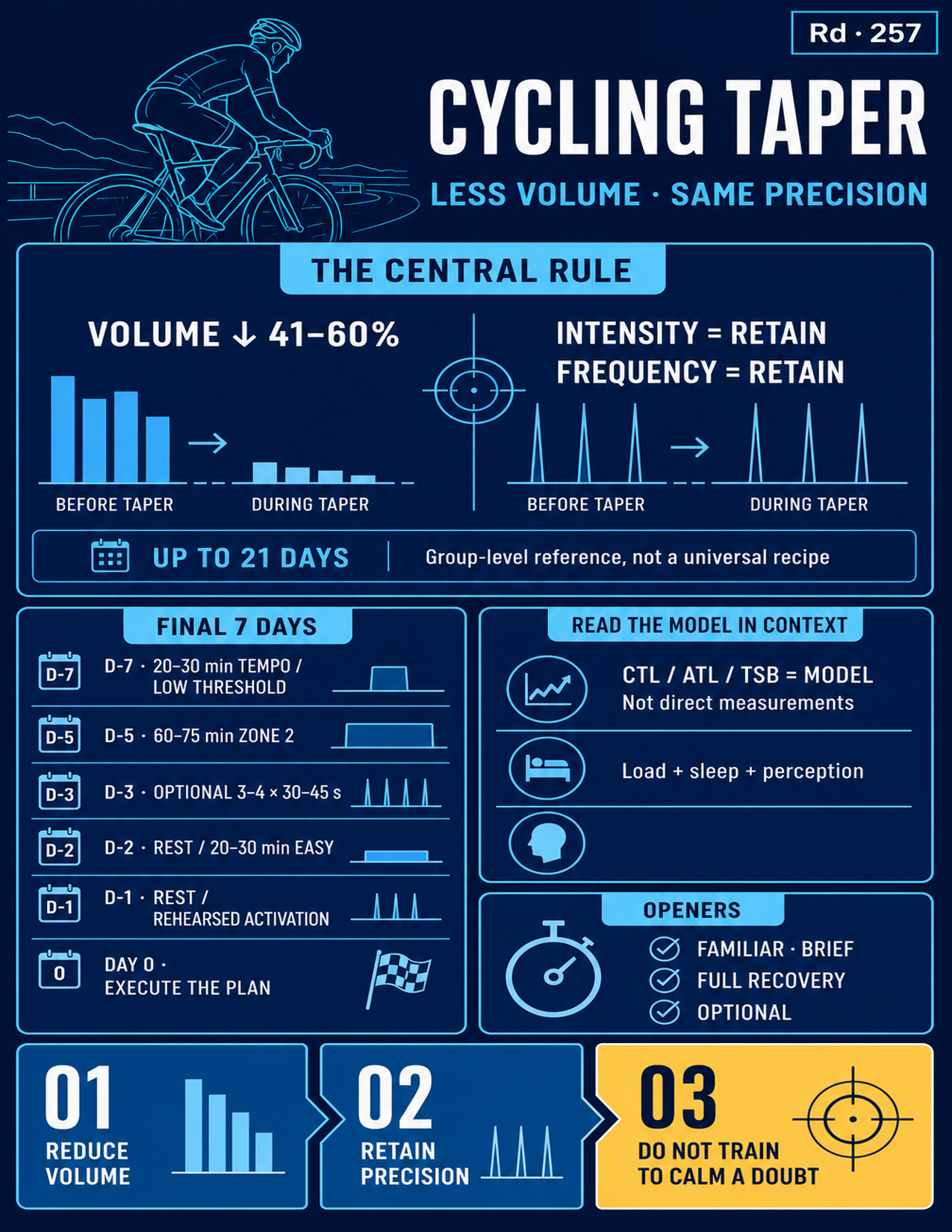
The practical answer is more restrained: a taper cuts enough volume to reduce fatigue, retains small doses of intensity and avoids introducing new stimuli. Evidence in endurance athletes supports a progressive 41–60% volume reduction, with intensity and frequency maintained, across no more than twenty-one days as a starting point.[1] This is a group-level finding across different sports, not an exact formula for every cyclist.
What does a taper actually do?
A taper is a planned training phase before competition. Its purpose is not to erase every trace of fatigue or increase aerobic capacity in one week. It reduces the residual cost of preceding load without completely removing the stimuli that preserve race feel.
The classic fitness–fatigue model helps visualise this. A training dose creates a slower positive response and a faster negative response. When load falls, the fatigue component can decline before accumulated adaptation does. Yet this remains a simplified mathematical model, with documented stability and prediction limits. It is not a direct reading of your muscles, nervous system or Sunday performance.[2]
How long should it last?
A meta-analysis of competitive athletes favoured a two-week taper with an exponential 41–60% volume reduction and no change in intensity or frequency.[3] The 2023 review found significant time-trial improvements with strategies lasting up to twenty-one days and the largest pooled effect between eight and fourteen days, although that subgroup contained few datasets.[4]
Use those findings as design boundaries, not an automatic calendar:
| Context | Starting point | What may change it |
|---|---|---|
| Short event and moderate preceding load | 7–10 days | Less accumulated fatigue may need a smaller reduction |
| Gran fondo or priority event after a demanding block | 10–14 days | High preceding volume or travel may justify starting earlier |
| High fatigue, concentrated block or very long event | Up to 21 days | Make sure the reduction does not remove too much rhythm or frequency |
Duration depends on what you need to unload. A cyclist training five hours per week should not copy the taper of someone coming from fifteen. Nor should you extend it because one isolated session felt heavy.
What should you reduce and retain?
The primary variable is volume: fewer minutes, fewer repetitions and a much shorter long ride. Frequency can remain through brief sessions when that supports routine without adding logistical load. Intensity is retained as quality, not quantity.
In one small study of trained cyclists, seven days with a 50% volume reduction and intensity maintained improved a simulated twenty-kilometre time trial; 30% and 80% reductions did not produce the same statistical improvement.[5] Only eleven men participated and the groups were very small. The result supports a moderate reduction; it does not prove that 50% is your optimum.
The execution rule is simple:
- retain one or two brief contacts with event-specific intensity;
- shorten efforts and reduce the repetition count;
- recover fully between short efforts;
- remove work that causes soreness, empties glycogen or needs several recovery days;
- do not introduce new strength work, position changes, equipment or nutrition.
Retaining intensity does not mean running one last fitness test. If a session is long enough to make recovery uncertain, it is no longer serving the taper.
How to read CTL, ATL and TSB during a taper
In training platforms, CTL summarises chronic load, ATL acute load and TSB the difference between them according to configured time constants. ATL will usually fall quickly, CTL more slowly and TSB can become positive. That describes the model's arithmetic from recorded load.
It does not mean CTL is your physiological fitness, ATL all your fatigue or TSB your competitive form. These models do not independently include sleep, illness, stress, travel, heat, carbohydrate availability or file quality.[6]
Use the trend to answer specific questions:
- Is load falling by the amount you planned?
- Can you execute the brief quality doses without residual fatigue?
- Are sleep, willingness and submaximal performance improving?
- Is a symptom hiding behind a positive number?
A positive TSB can accompany a good taper. It cannot certify one.
Do you need sprints or openers before racing?
Openers are short efforts used to preserve familiarity with high power and rehearse the feeling of activation. They can suit cyclists who already use them. Evidence does not justify claiming that three or four sprints several days before a race must “wake up” fibres that rest has switched off.
A recent systematic review and meta-analysis found no convincing overall evidence that post-activation enhancement improves endurance performance.[7] Much priming research also studies hours rather than days before performance and uses different protocols.
Treat openers as an individual option:
- use efforts you already know;
- allow complete recovery;
- finish feeling capable of doing more;
- avoid a maximal sprint if it raises risk or leaves soreness;
- compare complete rest with a short activation at lower-priority events.
A flexible protocol for the final seven days
This template does not replace your history. It assumes an endurance event on day zero and enough preceding load to require a taper.
| Timing | Objective | Example session |
|---|---|---|
D−7 | Last structured contact | Short session with 20–30 min total at tempo or low threshold, without emptying yourself |
D−5 | Retain frequency | 60–75 min easy in zone 2, without chasing speed |
D−3 | Optional activation | 40–50 min with 3–4 familiar 30–45 s efforts and full recovery |
D−2 | Reduce fatigue | Rest or 20–30 min very easy |
D−1 | Arrive calm | Rest or 20–30 min with two brief accelerations if you know that helps |
Day 0 | Execute | Rehearsed warm-up, pacing and nutrition already decided |
For a long event, specific work on D−7 may be more useful than maximal efforts. If fatigue is high, reduce earlier. If you travel, count the journey as load and protect sleep, meals and time on your feet.
Why can you feel strange during a taper?
A change in routine can make every sensation more noticeable. Taper psychology research describes changes in mood, perceived fatigue, wellness, stress and preparation, while also highlighting limited evidence and poorly diverse samples.[8] “Taper madness” is an informal label, not a physiological diagnosis.
Muscle glycogen can also increase during taper, which may come with more stored water and a sense of muscular fullness.[9] This does not explain every weight change, ache or heavy-leg sensation.
Sleep and carbohydrate in the final hours
Less training does not compensate for poor sleep caused by logistics. Keep regular hours, prepare equipment early and do not turn the eve of the race into an overnight operation. Before an early start, rehearse your wake-up and breakfast timing.
For prolonged events, higher carbohydrate availability in the preceding hours or days can support performance. Need and quantity depend on event duration, intensity, body size and tolerance.[10] Use a nutrition protocol you have practised. A taper is not the time for an extreme first carbohydrate load, new supplements or unfamiliar foods.
The final checklist
Before adding training, confirm five things:
- Volume: clearly below your normal week.
- Intensity: present in small, familiar doses.
- Recovery: no session needs several days to absorb.
- Logistics: bike, travel, sleep and nutrition are resolved.
- Judgment: you are not using training to seek emotional reassurance.
A taper cannot give you fitness you did not build. It does not erase that fitness because your legs feel different on Tuesday. Reduce volume, retain precision and reach the start with more desire to race than need to test yourself.
References
- Effects of Tapering on Performance in Endurance Athletes: A Systematic Review and Meta-Analysis — PLOS ONE, 2023↩
- The Use of Fitness-Fatigue Models for Sport Performance Modelling — Frontiers in Sports and Active Living, 2022↩
- Effects of Tapering on Performance: A Meta-Analysis — Medicine & Science in Sports & Exercise, 2007↩
- Effects of Tapering on Performance in Endurance Athletes: A Systematic Review and Meta-Analysis — PLOS ONE, 2023↩
- Effects of Different Stepwise Reduction Taper Protocols on Cycling Performance — Canadian Journal of Applied Physiology, 2003↩
- The Use of Fitness-Fatigue Models for Sport Performance Modelling — Frontiers in Sports and Active Living, 2022↩
- No Evidence of Postactivation Performance Enhancement on Endurance Exercises — Medicine & Science in Sports & Exercise, 2024↩
- The Psychology of Athletic Tapering in Sport: A Scoping Review — Sports Medicine, 2023↩
- Physiological Changes Associated with the Pre-Event Taper in Athletes — Sports Medicine, 2004↩
- Carbohydrates for Training and Competition — Journal of Sports Sciences, 2011↩
labels.help_guides_eyebrow
labels.help_guides_title
labels.help_guides_description
Create and adjust your annual training plan
Build a season plan with training blocks and weekly targets, apply it to your calendar, and modify it when life happens.
Turn on and read the morning readiness email
Opt in to a morning readiness verdict on workout days, choose your send hour, and understand what drives the recommendation.
Visual summary
The article at a glance
Review the key concepts in one infographic.