Gran fondo pacing strategy: how to finish strong
Build a sector-by-sector gran fondo pacing plan for power, climbs, drafting and fueling so you preserve the option to finish strongly.
Listen to this article
You can reach kilometre 120 with options or start surviving much earlier. Fitness matters, but on event day the difference also lies in how you distribute a limited capacity.
The direct answer is to build a sector-by-sector plan: a controlled start without giving away useful speed, power ceilings for climbs, shelter in the group, safe recovery on descents, fueling from the beginning and a clear rule for deciding whether to increase your effort in the second half. The goal is not to ride slowly. It is to stop the emotion of the opening kilometres from deciding what you can produce near the finish.
Should you aim for a negative split?
A negative split means covering the second half faster than the first. As an intention, it encourages restraint. As a universal prescription, it is too simple for a gran fondo shaped by elevation, wind, traffic and changing groups.
A systematic review and network meta-analysis compared imposed fast, even and slow starts with self-selected pacing. It found no consistent advantage for one strategy over another, and a prolonged slow start could impair performance.[1] The practical reading is not “always start slower”; it is avoid a start you cannot justify from the course and your plan.
In a long event, good execution often looks even when judged by effort, even though speed changes with the terrain. You can produce more uphill and little on a descent without abandoning the plan. Cost, not the speedometer, is what should remain controlled.
Why early spikes cost so much
Muscle and liver glycogen are limited. Their use changes with intensity, duration, training status and carbohydrate availability; carbohydrate becomes more important as intensity rises.[2] A sequence of hard exits from corners, short climbs and pulls early in the day can therefore consume resources you will need several hours later.
That does not mean a bonk behaves like a tank flipping instantly from full to empty. The performance decline associated with low carbohydrate availability can coexist with heat, hydration, duration, neuromuscular fatigue and pacing decisions. Nor is there a universal equivalence such as “one minute in zone 5 costs twice as much as one minute in zone 3.”
Kolsung and colleagues compared constant and variable efforts matched for average power in fifteen elite competitive cyclists. The response depended on intensity and the variation pattern; physiological differences became clearer when fluctuations crossed lactate threshold.[3] Average power can hide the price of accelerations.
Your first defence is a power ceiling, not a copied percentage. It should come from recent efforts of comparable duration, your goal for the day, elevation, heat and your ability to fuel. FTP organizes the conversation, but it does not turn 75%, 80% or any other value into a law for every rider.
How to turn the course into a power plan
Study the route file before the event and split it wherever the decision changes: start, long climbs, short rises, exposed flats, descents, feed zones and final third. Give every sector a range, a ceiling and an action.
| Sector | Objective | Power rule | Practical action |
|---|---|---|---|
| Start and opening kilometres | Avoid emotional accelerations | Low end of your sustainable range for the day | Find a compatible group without chasing every split |
| Long climb | Protect an effort you can repeat | A range tested for that duration with an explicit ceiling | Give up positions before turning the climb into a test |
| Short rise | Preserve momentum without chaining spikes | Allow a brief increase only if recovery follows | Do not sprint over every crest by reflex |
| Flat road and group | Reduce power for a given speed | Use the draft; do not confuse speed with effort | Stay sheltered and avoid unnecessary pulls |
| Descent | Recover without compromising safety | Pedal when it adds value; power may fall | Relax your grip, look ahead, and eat or drink only when safe |
| Final third | Turn remaining margin into performance | Increase within the planned range if signals remain stable | Build progressively instead of launching an impulsive attack |
A worked example with fictional numbers
Imagine a rider with a 250 W FTP and experience holding steady power for four or five hours. Their sheet might show 165–180 W on exposed flats, 190–205 W on long climbs and a brief ceiling of 220 W for selected rises. These are not targets for you. The example shows the structure: range, duration and ceiling by terrain.
Test the plan before you pin on a number. Use a long ride with similar elevation, the same power meter and the intended nutrition. If the power feels prudent for two hours but leaves no capacity in the fourth, the file has answered your question.
How to manage climbs without giving away your event
The gradient invites you to follow other riders' speed. Your power meter shows what that speed costs you. On the early climbs, pay particular attention to accelerations where the gradient changes and to the minutes after losing a wheel: chasing it may cost more than finding the next group.
You do not need to produce exactly the same power over every metre of a rolling course. A study of seven cyclists tested a strategy of about +5% uphill and −5% downhill relative to mean power; some participants could not execute all of that variation.[4] The small sample does not turn the percentage into a prescription, but it reinforces a useful point: variation must be tolerable and rehearsed.
Use your strictest ceiling on climbs before the halfway point. On the decisive final climb, you can spend the margin you preserved if perceived exertion, fueling and your ability to maintain technique remain under control.
How much can you save in the group?
Drafting reduces aerodynamic resistance, but there is no fixed 20–30% saving that applies everywhere. Position, spacing, speed, crosswind, group size and gradient change the benefit.
Blocken and colleagues' simulations and wind-tunnel tests found that in compact pelotons of 121 cyclists without crosswind, drag in deeply sheltered positions could fall to 5–10% of that experienced by an isolated rider.[5] That is an aerodynamic result under modelled conditions, not a promise of metabolic savings in your gran fondo.
Drafting can matter uphill when speed is high enough. In a model validated with wind-tunnel testing, following another cyclist on a 7.5% gradient at about 22 km/h reduced the total required power by around 7%; the saving grew with speed and position in the line.[6]
The practical consequence is simple: protect your position without turning it into a constant fight. Riding ten watts lower in a stable group can be worth more than gaining twenty places through a surge you later have to repay. In crosswinds, on narrow roads or in a nervous group, safety outranks any theoretical saving.
Fueling is part of pacing
Power and nutrition are not separate plans. If you wait for hunger, the intensity that felt sustainable may stop being so.
For one to two and a half hours with sustained work, 30–60 g/h of carbohydrate is a common starting point. In events beyond two and a half or three hours, intake can approach 90 g/h when intensity, tolerance and gut training justify it; high intakes generally use multiple transportable carbohydrates such as glucose and fructose.[7]
Do not wait forty-five or sixty minutes to remember the entire plan at once. Divide your hourly target into smaller feeds, perhaps every twenty to thirty minutes, and begin during the first hour. The exact format—drink, gel, bar or food—should already have worked in training.
What to decide before kilometre zero
Prepare a short sheet you can remember when the group accelerates:
- Decision map. Mark climbs, estimated duration, exposed roads, poor surfaces, descents and feed zones.
- Ranges by sector. Set target power, ceiling and tolerable duration; add a perceived-effort reference in case the power meter fails.
- Fueling and hydration plan. Count grams per hour, units carried, refill points and fluid for the expected conditions.
- Group rule. Decide the highest power you will accept to close a gap and when you will let a wheel go.
- Permission to increase. Specify which signals must be present before you release intensity in the final third.
You also need a plan B. Extra heat, wind, gastrointestinal trouble or a puncture changes the problem. Adjusting the objective is not quitting; it prevents an impossible plan from continuing to make poor decisions for you.
How to decide in the second half
At halfway, do not ask only, “Do I feel good?” Review a set of signals:
| Signal | Reading | Decision |
|---|---|---|
| Power within range and stable perceived effort | Cost remains controlled | Hold and reassess before the final key sector |
| Heart rate or effort rises at the same power | Heat, fatigue or low availability may be developing | Ease for several minutes, drink or eat according to plan, then observe |
| Feeds completed and stomach stable | Nutrition remains executable | Continue with small, regular amounts |
| Heavy legs, lower concentration or worsening technique | Your margin is shrinking | Reduce intensity before deterioration grows |
| Final climb, stable signals and tested margin | You can convert reserve into performance | Build progressively within the planned range |
A strong finish does not require an attack. It may be as simple as holding your target power while others reduce theirs. That is the reward for protecting the first half.
The three rules to remember
First, control cost, not speed: terrain and groups change speed without telling you what you can sustain. Second, set ranges by sector and rehearse them: a generic percentage of FTP does not know your duration, ability or course. Third, eat before you need it and increase only when the evidence allows it.
Gran fondo strategy is not about staying conservative forever. It is about preserving the option to be fast when it still matters.
References
- Comparative Effects of Pacing Strategies on Endurance Performance: A Systematic Review and Network Meta-Analysis — Sports Medicine, 2026↩
- Regulation of Muscle Glycogen Metabolism during Exercise: Implications for Endurance Performance and Training Adaptations — Nutrients, 2018↩
- Physiological Response to Cycling With Variable Versus Constant Power Output — Frontiers in Physiology, 2020↩
- Acceptability of Power Variation during a Simulated Hilly Time Trial — International Journal of Sports Medicine, 2007↩
- Aerodynamic Drag in Cycling Pelotons: New Insights by CFD Simulation and Wind Tunnel Testing — Journal of Wind Engineering and Industrial Aerodynamics, 2018↩
- Aerodynamic Analysis of Uphill Drafting in Cycling — Sports Engineering, 2021↩
- A Step Towards Personalized Sports Nutrition: Carbohydrate Intake During Exercise — Sports Medicine, 2014↩
labels.help_guides_eyebrow
labels.help_guides_title
labels.help_guides_description
Configure and review your FTP and power zones
Set the right reference in Intervals.icu, sync it, and check exactly which FTP and zones Ridium is using.
Turn on and read the morning readiness email
Opt in to a morning readiness verdict on workout days, choose your send hour, and understand what drives the recommendation.
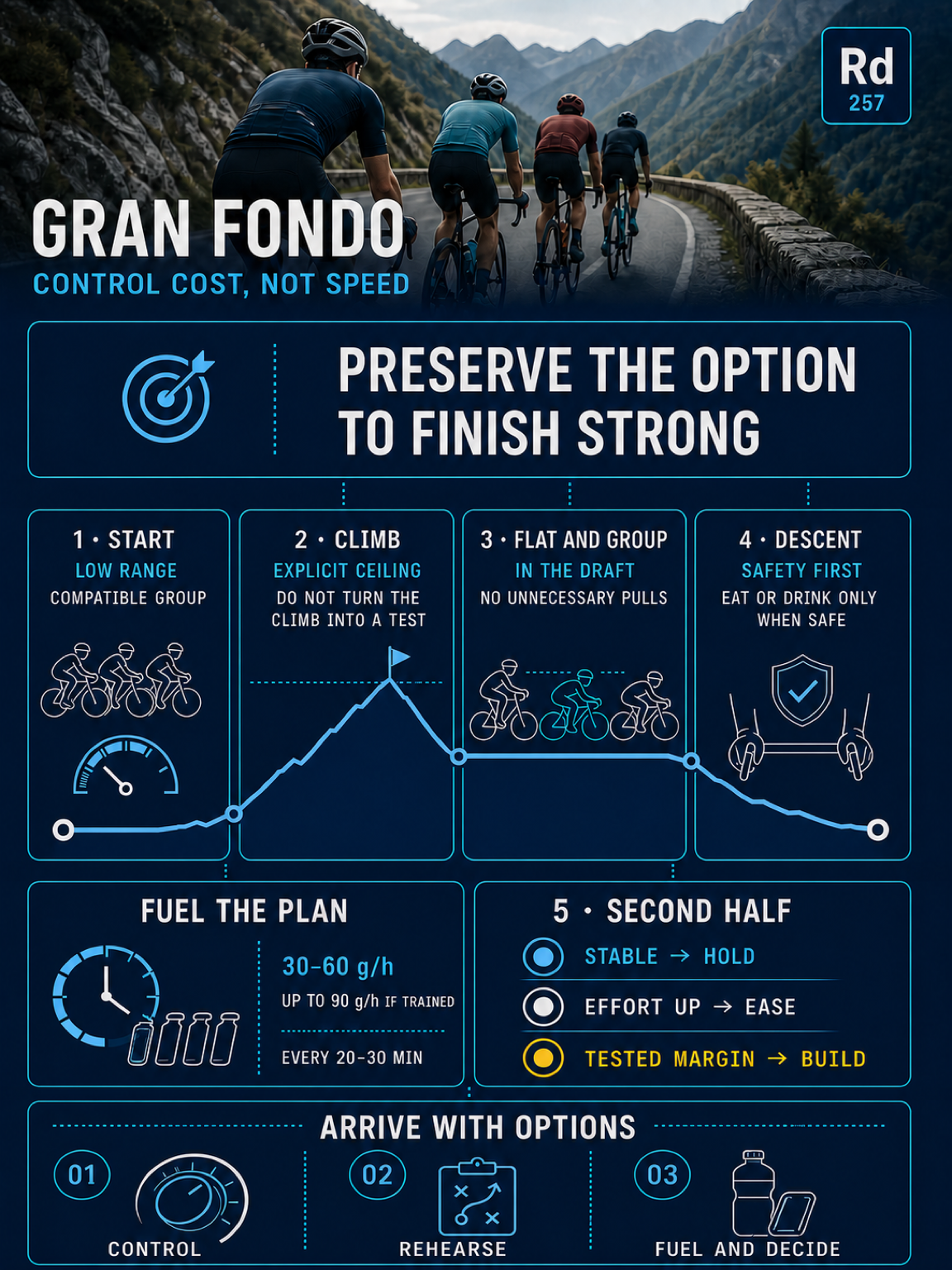
Visual summary
The article at a glance
Review the key concepts in one infographic.