Group rides: how to fit them into your cycling training
Use drafting, variable efforts and bunch skills without turning every group ride into a hard day or disrupting the rest of your training week.
Listen to this article
A group ride can be the best training of your week and the ride most likely to break its structure. Once you join the bunch, you no longer control the pace completely. The wheel, wind, climbs and other riders' decisions determine the power you need to produce.
That does not make the group a problem. It provides volume, aerodynamic efficiency, changes of pace, bunch skills and a social reason to stay on the bike for hours. The key is to assign the ride a purpose before you leave and evaluate what actually happened afterwards.
The direct answer is this: a group ride fits when its likely cost matches the purpose of the day and leaves the important sessions that follow intact. If the bunch turns an easy endurance day into a race, count it as a hard day even when average power looks moderate.
Why riding on a wheel makes you faster
Following other cyclists exposes you to less head-on airflow and reduces aerodynamic drag. The benefit is not constant. It changes with speed, wind, wheel gap, lateral position, group size and shape, and your own posture.
Blocken and colleagues modeled two pelotons of 121 cyclists and validated the simulations in wind-tunnel tests. Every modeled rider experienced less drag than an isolated cyclist, while protected positions in the middle and rear received much larger reductions than those usually observed in a small paceline.[1] This is a result about aerodynamic drag in a tightly packed formation, not an energy-saving promise for every real group ride.
Field physiology points in the same direction. In the classic study by McCole and colleagues, riding at 40 km/h behind a group of eight reduced oxygen uptake by 39 ± 6% compared with riding alone under those conditions.[2] The number depends on the protocol and should not become “you will save thirty percent” without knowing speed, position, spacing and wind.
What a group ride actually trains
A controlled bunch can accumulate several hours of aerobic work with less mental friction than a solo ride. It also makes you read the wind, hold a wheel, choose position, fuel while moving and respond to speed changes. If your goal includes a gran fondo, sportive or road race, those skills are part of specificity.
But “group ride” does not describe one intensity. It may be a conversational zone 2 ride, a sustained paceline, a hilly route with regrouping, or an informal race in which every climb finishes above threshold. Before you place it in the plan, know three things:
- the group's pace and rules;
- the terrain and usual acceleration points;
- your ability relative to the other riders.
The same bunch may be endurance work for the rider who stays sheltered and a high-intensity session for the rider who repeatedly closes gaps. A shared speed does not mean a shared training load.
Why average power can understate a hard group ride
Average power combines pedaling, coasting, descents, pulls and attacks into one number. Two rides may both finish at 180 W average and make different demands: one can be steady; the other can alternate zeros, accelerations and minutes near or above threshold.
Kolsung and colleagues compared twenty minutes of constant power with variable protocols matched for average power in fifteen elite competitive cyclists. Variable power produced higher mean oxygen uptake, heart rate and lactate responses; the effect was clearest when fluctuations crossed lactate threshold.[3] The study does not assign a fixed penalty to every group ride, but it shows that matching the average does not necessarily match the demand.
Use VI as a clue, not a verdict
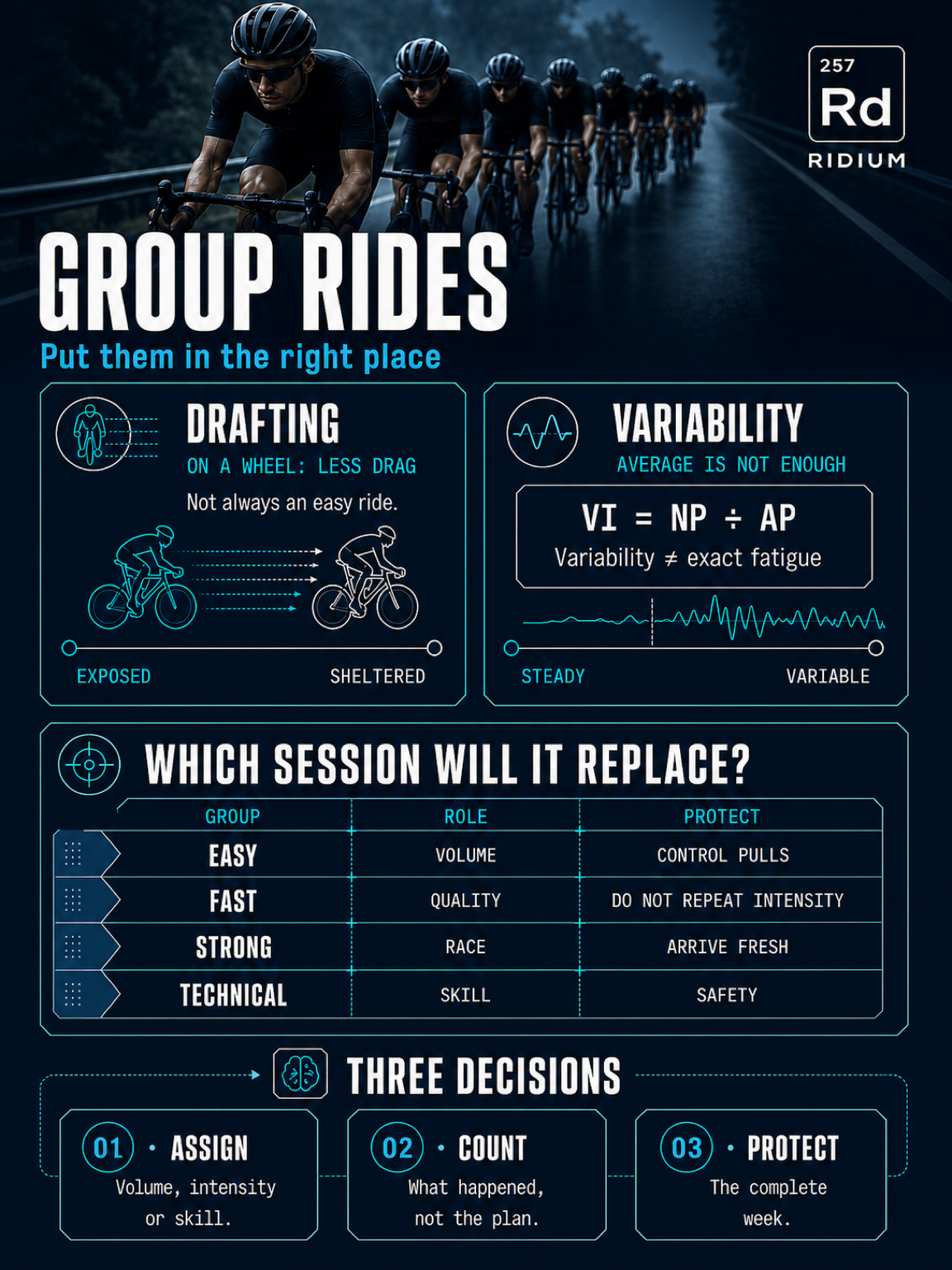
The Variability Index, or VI, divides normalized power by average power. TrainingPeaks uses it to summarize the separation between weighted demand and the average.[4]
VI = normalized power ÷ average power
A higher VI indicates more variability within that model, not an exact amount of fatigue. There is no universal cutoff that makes a ride good or bad. Read it alongside:
- total duration and accumulated work;
- time above zone 2 and threshold;
- the number and duration of power spikes;
- heart rate and perceived exertion;
- fueling, heat and fatigue before the ride;
- the quality of the following day's session.
How to place a group ride in your week
Do not start by asking whether group rides are good or bad. Ask which session this ride will replace.
| Likely group behavior | Reasonable role in the plan | What to protect |
|---|---|---|
| Conversational pace, familiar route and regrouping | Aerobic volume | Keep pulls and climbs controlled |
| Sustained rotations and competitive climbs | Unstructured quality day | Recover before and after; do not duplicate intensity |
| Stronger group with repeated surges | Race specificity or an intense stimulus | Arrive fresh and accept that the following day may change |
| Technical group at a moderate pace | Practice wheels, signals, positioning and fueling | Put safety ahead of watts or speed |
| Unpredictable ride before key intervals | Risk to the next session | Choose another group, leave early or ride solo |
If key intervals are scheduled the following day, the ride before them needs to be genuinely controllable. “I will try not to push” is not a plan when you know you will chase every attack. You have three honest options: choose an easier group, leave before the competitive section, or move the hard session within the week.
If the fast group is the stimulus you want, treat it that way. Do not add threshold work afterwards just because the file lacks perfectly shaped repetitions. A lack of structure does not remove the intensity.
Three ways to use the bunch without losing the plan
1. Declare the purpose before you start
Choose one main purpose: volume, intensity, skill or social enjoyment. Secondary benefits are welcome, but the priority governs your decisions. If the goal is endurance, skipping a sprint does not ruin the ride. If you want race specificity, arriving fresh matters more than adding extra volume the previous day.
2. Agree on pace, route and hard sections
A simple agreement prevents many accidental workouts: keep the first two hours controlled, ride hard on one named climb, then regroup at the top. Also find out whether the ride follows a no-drop policy or expects riders to look after themselves.
Communication is not only a training tool. Cycling UK identifies group awareness and communication as central safety practices and recommends warning others about changes of pace, direction and road hazards.[5] Exact calls vary by country and club; learn the group's conventions before riding close.
3. Choose the group for the phase of your season
During a base phase, a steady group close to your level can help you accumulate hours without turning every weekend into a race. During development or near an event, a faster bunch may add surges, positioning and decisions under fatigue.
This is a practical framework, not a law of periodization. If the fast group repeatedly compromises work specific to your goal, it has stopped complementing the plan and started directing it by accident.
Skills you only practice properly with other riders
An indoor trainer can reproduce variable power, but it cannot reproduce physical interaction with a bunch. Group riding teaches you to:
- hold a predictable line;
- look beyond the rider immediately in front;
- modulate speed without sudden braking;
- signal hazards and relay messages;
- enter and leave a rotation;
- preserve position before a climb or corner;
- eat and drink without losing control;
- distinguish a small gap from a costly loss of the wheel.
These skills do not appear as a higher FTP. They can still decide whether you can use your fitness when an event becomes fast, technical or nervous.
How to evaluate the ride afterwards
Review it in two layers.
First, the training: duration, normalized power, VI, time in zones, relevant spikes, heart rate, perceived exertion and fueling. Ask whether the file matches the purpose you assigned.
Then, the consequence: can you execute the next important session? Was fatigue close to what you expected? Did the group let you practice the skill you wanted? An enjoyable ride that forces you to cancel two key workouts can still be a good experience, but it was not easy volume.
Keep three decisions:
- Assign a purpose before you leave. Volume, intensity, skill or social enjoyment.
- Count what happened, not what the calendar said. If the ride contained intensity, record a hard day.
- Protect the complete week. The group adds value when it complements your plan instead of replacing it without you noticing.
Training with power does not require abandoning the bunch. It requires reading it better. The group can carry you faster, teach you to move and give you hours you would not complete alone. Your job is to decide when to use that force and when to let the wheel go.
References
- Aerodynamic Drag in Cycling Pelotons: New Insights by CFD Simulation and Wind Tunnel Testing — Journal of Wind Engineering and Industrial Aerodynamics, 2018↩
- Energy Expenditure During Bicycling — Journal of Applied Physiology, 1990↩
- Physiological Response to Cycling With Variable Versus Constant Power Output — Frontiers in Physiology, 2020↩
- An Introduction to TrainingPeaks Metrics: Part Two — TrainingPeaks↩
- Essential Guidelines for Safe Riding — Cycling UK, updated 2025↩
labels.help_guides_eyebrow
labels.help_guides_title
labels.help_guides_description
Configure and review your FTP and power zones
Set the right reference in Intervals.icu, sync it, and check exactly which FTP and zones Ridium is using.
Visual summary
The article at a glance
Review the key concepts in one infographic.